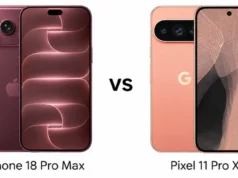
The iPhone 18 Pro Max and Google Pixel 11 Pro XL take noticeably different paths when it comes to premium smartphones. Apple puts its emphasis on raw performance, professional video, hardware quality and ecosystem integration, while Google concentrates on computational photography, artificial intelligence and the flexibility of Android. With both devices positioned near the $1,300 price point, these differences become important for anyone planning to keep their flagship for several years.
Major Features:
| Category | iPhone 18 Pro Max | Pixel 11 Pro XL | Winner |
|---|---|---|---|
| Build | Ceramic Shield 2, aluminum frame, IP68 | Gorilla Glass Victus 2, aluminum frame, IP68 | Apple: Stronger protection |
| Display | 6.9 inch LTPO OLED, 120Hz, Dolby Vision | 6.8 inch LTPO OLED, 120Hz, HDR10+ | Apple: Dolby Vision support |
| Peak Brightness | Up to 3000 nits | Up to 3600 nits | Google: Higher peak brightness |
| Processor | A20 Pro, 2nm | Tensor G6, 3nm | Apple: Performance focused chip |
| RAM | 12GB | Up to 16GB | Google: More RAM available |
| Storage | Up to 2TB | Up to 1TB | Apple: Higher maximum capacity |
| Main Camera | 48MP triple camera | 50MP triple camera | Google: Larger main sensor |
| Telephoto | 48MP, 4x optical zoom | 48MP, 5x optical zoom | Google: Longer optical reach |
| Ultrawide | 48MP, 120° | 48MP, 123° | Google: Slightly wider field |
| Video | Up to 4K 120fps, ProRes RAW, Dolby Vision | Up to 8K 30fps | Apple: More professional video tools |
| Selfie Camera | 18MP ultrawide, PDAF | 42MP ultrawide, PDAF | Google: Higher resolution |
| Battery | Up to 5567mAh, market dependent | 5115mAh | Apple: Larger stated capacity |
| Wired Charging | 50% in 15 minutes | 75% in 30 minutes | Apple: Faster initial charging |
| Wireless Charging | 25W MagSafe/Qi2 | 25W magnetic Qi2.2 | Tie: Similar rated speeds |
| Software | iOS 27 | Android 17, 7 major OS updates | Google: Longer stated update commitment |
| Price | Approx. $1,300 / ₹180,000 | Approx. $1,300 / ₹135,000 | Google: Lower Indian price |
| Value | Premium performance and video | Strong cameras, AI and lower price | Google: More affordable package |
| Overall | Performance and creator focused flagship | AI and photography focused flagship | Apple: Stronger overall package |
Disclaimer: Specs are based on available data. Actual performance may vary. Verify details from official sources before buying.
1. Design and Display
Build and Feel
The iPhone 18 Pro Max features a Ceramic Shield 2 front, an aluminum frame and Ceramic Shield rear construction, along with IP68 protection designed for deeper water immersion. The Pixel 11 Pro XL uses Gorilla Glass Victus 2 on its front and back, paired with an aluminum frame and IP68 protection as well. Apple’s construction appears better suited to demanding everyday use, especially because of its upgraded front glass protection.
Both smartphones offer the premium feel expected from flagship devices, although each follows a different design direction. Apple focuses on durability and a tightly integrated hardware ecosystem, while Google maintains its recognizable Pixel appearance and established Android flagship character. With Ceramic Shield 2 and its enhanced water resistance specification, the iPhone has a practical advantage for people who place greater importance on durability and long term protection.
Display Quality
The iPhone comes with a 6.9 inch LTPO Super Retina XDR OLED display featuring a 120Hz refresh rate, HDR10 and Dolby Vision. Google equips the Pixel with a 6.8 inch LTPO OLED panel offering 120Hz, HDR10+ and a higher claimed peak brightness. This gives the Pixel an appealing advantage for outdoor viewing and HDR content.
Verdict
Apple brings stronger physical protection and Dolby Vision, while Google delivers greater claimed peak brightness. The iPhone provides a more refined overall display experience, although the Pixel remains a strong option for users who place brightness at the top of their priorities.
2. Specifications Including Battery
Performance
The iPhone 18 Pro Max is powered by Apple’s A20 Pro chip, manufactured using a 2nm process, alongside 12GB of RAM and NVMe storage. The Pixel 11 Pro XL relies on Google’s Tensor G6, built on a 3nm process, with up to 16GB of RAM and UFS 4.x storage. Apple’s hardware is more focused on high performance, whereas Google puts greater emphasis on AI processing and software integration.
For demanding games, sustained workloads and professional tasks, the A20 Pro specifications point toward a more performance oriented setup. The Tensor G6, on the other hand, is designed around areas such as Google’s AI capabilities, computational photography and closely integrated Android functions. Although the Pixel provides more RAM, memory capacity by itself does not determine how quickly a phone performs in everyday use.
Battery and Charging
The iPhone has different battery capacities depending on the market, with wired charging capable of reaching 50% in 15 minutes. It also supports 25W MagSafe and Qi2 wireless charging. The Pixel 11 Pro XL includes a 5115mAh battery and supports 45W wired charging, reaching 75% in 30 minutes. It also includes 25W magnetic wireless charging, reverse charging and bypass charging.
Verdict
The iPhone is built around high performance and rapid charging, while the Pixel provides a wider selection of charging features. Users focused heavily on performance may prefer Apple’s approach, whereas Pixel offers greater flexibility for different charging needs.
3. Camera
Main and Secondary Lenses
The iPhone 18 Pro Max features a triple 48MP camera system consisting of a wide camera, 4x periscope telephoto and ultrawide lens. Google’s Pixel combines a 50MP main camera with a 48MP 5x periscope telephoto and a 48MP ultrawide camera. Pixel provides greater native optical reach and a slightly wider ultrawide perspective, while the iPhone includes LiDAR for depth sensing and more advanced imaging applications.
Video remains one of the iPhone’s strongest areas, with support for 4K recording at up to 120fps, Dolby Vision, ProRes, ProRes RAW and Apple Log 2. Google responds with 8K video recording, Ultra HDR, Pixel Shift, Best Take and Zoom Enhance. For users creating professional video content, Apple offers the broader collection of advanced recording controls.
Selfie Camera
The iPhone features an 18MP ultrawide selfie camera with PDAF and SL 3D depth sensing. The Pixel 11 Pro XL uses a 42MP ultrawide front camera with PDAF. Both devices support 4K front camera recording, although Apple adds Dolby Vision, ProRes RAW and Apple Log 2 to its front camera video capabilities.
Verdict
The Pixel provides greater native zoom capability and a higher resolution selfie camera, while Apple offers a much wider selection of professional video features. For creators who place particular importance on video production, the iPhone provides the more extensive camera toolkit.
4. Pricing
The iPhone 18 Pro Max is listed at approximately $1,300 or ₹180,000, while the Pixel 11 Pro XL is around $1,300 or ₹135,000. Although their US prices are similar, the supplied figures show a substantial difference in India, where Google’s flagship is listed at a considerably lower price.
The higher Indian price of the iPhone reflects the premium associated with Apple’s flagship positioning, ecosystem and professional capabilities. The Pixel’s lower price makes features such as up to 16GB of RAM, 5x optical zoom, a brighter display and flexible charging more accessible. For shoppers comparing specifications with the initial purchase cost, Google offers the lower priced option.
Is the price justified?
At approximately the same US price, both smartphones offer different reasons for their flagship positioning. The iPhone is aimed at people who value high performance, professional video creation and Apple’s ecosystem. Pixel focuses more strongly on artificial intelligence, photography and the flexibility provided by Android.
Verdict
Based on the supplied Indian prices, Pixel provides greater value at the lower cost, while the iPhone supports its higher price through performance and professional video features. The choice ultimately depends on the user’s preferred ecosystem and the features they intend to use most.
Disclaimer:
Prices are approximate and may vary depending on the country, region, launch period and applicable taxes. Always confirm whether the listed price applies to a China model or a global or international variant before purchasing.
5. Conclusion
The iPhone 18 Pro Max distinguishes itself through the A20 Pro processor, LiDAR, ProRes RAW, Apple Log 2, Dolby Vision video and its extensive professional recording features. The Pixel 11 Pro XL responds with the Tensor G6, up to 16GB RAM, 5x optical zoom, 8K video, Zoom Enhance, Best Take, bypass charging and a 42MP ultrawide selfie camera.
Apple’s flagship is designed for people seeking maximum performance and a powerful tool for video production, while Google delivers a more extensive computational photography and AI focused experience. The Pixel also benefits from the lower Indian price shown in the supplied figures, making the comparison more complicated than simply looking at the specifications.
Verdict
Overall winner: iPhone 18 Pro Max. Its A20 Pro performance, professional video features, LiDAR capabilities and polished flagship ecosystem make it the more complete premium package, even though the Pixel offers a stronger value proposition.
FAQs
- Which phone has the better camera zoom?
The Pixel 11 Pro XL provides 5x optical zoom, while the iPhone 18 Pro Max offers 4x optical zoom.
- Which phone is better for gaming?
The iPhone 18 Pro Max is designed to handle demanding gaming more effectively because of its A20 Pro processor.
- Which phone charges faster?
The Pixel 11 Pro XL can reach 75% in 30 minutes, while the iPhone 18 Pro Max can reach 50% in 15 minutes.
- Which phone offers more RAM?
The Pixel 11 Pro XL is available with up to 16GB of RAM, compared with 12GB on the iPhone 18 Pro Max.
- Which phone is cheaper in India?
The Pixel 11 Pro XL is listed at approximately ₹135,000, making it substantially less expensive than the iPhone 18 Pro Max.
Disclaimer: Prices, specifications and availability can differ by region and retailer. Recommendations in this article are based on editorial opinion, feature based value and market positioning at the time of writing. Readers should conduct their own research before purchasing.
(via)