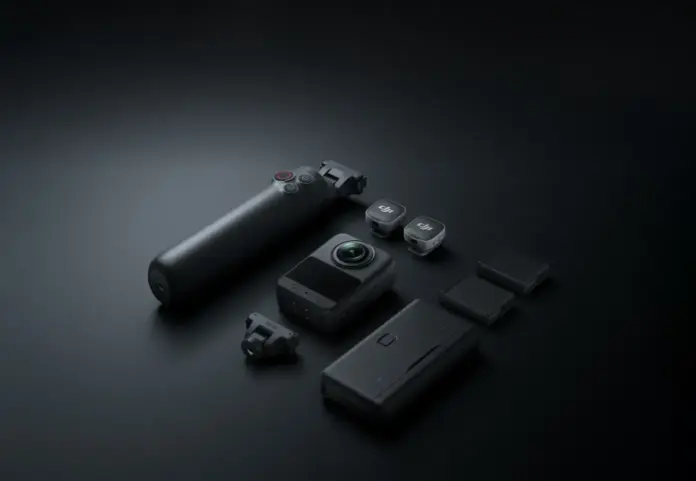
DJI has recently expanded its handheld camera lineup with two very different options, the Osmo 360 II and the Osmo Pocket 4P. Both cameras are compact and feature some of DJI’s latest imaging technology, but they are built for very different shooting styles. The right choice ultimately depends on whether you prefer immersive 360 degree footage or conventional video with professional stabilization.
1. Design and Build
The two cameras are designed with different environments in mind. The Osmo 360 II is built to handle demanding outdoor use, featuring an IP68 rating that allows it to withstand water immersion of up to 10 meters without an additional waterproof case.
It can also operate in temperatures as low as minus 20 degrees Celsius. DJI has equipped it with replaceable lens protectors, which should be useful for users who mount the camera on helmets, bikes, or other equipment where the lenses could be exposed to scratches and impacts.
2. Sensors and Image Quality
The biggest difference between the two cameras is their approach to image capture. The Osmo 360 II uses two 1/1.1 inch square CMOS sensors designed to make better use of the sensor area while recording native 8K panoramic video at up to 60fps.
It offers a 14.5 stop dynamic range, 10 bit color with D Log M, and an AI Super Night 2.0 mode for improved low light recording. Since the camera captures a full 360 degree view, users can choose their preferred framing later during editing.
The Pocket 4P takes a more conventional approach with its dual camera system. Its main wide angle camera features a 1 inch sensor with a 20mm equivalent focal length and f/2.0 aperture, along with LOFIC technology that DJI says can provide up to 17 stops of dynamic range.
The secondary camera uses a 1/1.28 inch sensor paired with a 60mm medium telephoto lens and f/1.8 aperture. It offers 3x optical zoom, making it useful for portraits and shots requiring stronger background compression. The camera can also record 4K video at up to 240fps and supports the D Log 2 color profile. For users who want traditional high quality footage straight from the camera, the Pocket 4P has the advantage.
3. Tracking, Storage, and Connectivity
Both cameras support subject tracking, although they achieve it differently. The Pocket 4P uses ActiveTrack 8.0 and physically moves its gimbal to keep subjects centered, including when using the telephoto camera.
The Osmo 360 II instead uses digital tracking by cropping into its 360 degree footage. This tracking output is currently limited to 4K resolution.
Both cameras come with built in storage. The Osmo 360 II provides 128GB, with roughly 105GB available to users, while the Pocket 4P includes 103GB. Both can also support storage expansion of up to 1TB.
The Pocket 4P offers USB 3.1 connectivity with transfer speeds reaching 800MB/s, making it convenient for moving large video files. For audio, the Osmo 360 II has four microphones, while the Pocket 4P uses a three microphone system. Both cameras can connect directly with DJI wireless microphones, including the Mic Mini 2.
Battery performance differs considerably. The Pocket 4P can record for up to 210 minutes at 1080p and can reach 80 percent charge in around 18 minutes. The Osmo 360 II offers up to 100 minutes of continuous recording on its 2150mAh battery, partly due to the heavier processing requirements of 8K video.
4. Which One Should You Buy?
The two cameras are priced fairly close together. In China, the Osmo 360 II starts at CNY 3,299, approximately $489, for the Standard Combo. The Osmo Pocket 4P starts at CNY 3,799, or roughly $563.
For action sports enthusiasts, motorcyclists, travelers, and creators who want immersive footage, the Osmo 360 II is the better option. Its native 8K capture provides plenty of room for reframing footage into conventional videos, while its IP68 protection makes it better suited to demanding outdoor environments.
For YouTubers, filmmakers, and travel creators who prefer traditional video, the Pocket 4P is the more attractive choice. Its 1 inch main sensor, 60mm telephoto camera, optical zoom, and mechanical gimbal provide excellent image quality, natural depth, and smooth stabilized footage in a compact package.
(source)