Recent camera comparisons indicate that the Galaxy S26 Ultra does bring noticeable improvements compared to its predecessor. However, according to early analysis from DxOMark, Samsung’s latest flagship still falls slightly behind Apple’s iPhone 17 Pro in several important areas.
Looking at the hardware specifications, the Galaxy S26 Ultra shares many similarities with the Galaxy S25 Ultra in terms of its camera setup. Samsung has retained the same 50 megapixel ultra wide camera with an f 1.9 aperture and a 1 over 2.52 inch sensor, as well as the 10 megapixel 3x telephoto lens with an f 2.4 aperture and a 1 over 3.94 inch sensor. The main upgrades focus primarily on the primary camera and the long range zoom system.
The most notable change is the 200 megapixel main camera, which now features a wider f 1.4 aperture instead of the previous f 1.7. Although the difference might appear small, Samsung claims the brighter aperture allows roughly 47 percent more light to reach the sensor. This should help improve detail and reduce noise when shooting in low light environments.
Samsung has also updated the 50 megapixel 5x periscope telephoto camera. The new system uses an f 2.9 lens and introduces a more compact Adaptive Lens on Prism design. One noticeable change is the appearance of the background blur. Highlights now appear more rounded instead of the squared shapes that were sometimes visible in earlier models. The downside is that the minimum focusing distance has increased to around 52 centimeters, which could make close up shots a bit more challenging.


According to DxOMark’s preliminary testing, these upgrades do bring real improvements. The Galaxy S26 Ultra reportedly captures more detail and produces less noise in low light situations. Skin tones also appear more accurate compared to the previous generation. Portrait photography seems improved as well, particularly in noise reduction and overall image balance.
Despite these enhancements, the Galaxy S26 Ultra still does not fully match the performance of Apple’s iPhone 17 Pro, which was introduced in September 2025. DxOMark points out that autofocus can occasionally struggle when identifying faces, and portrait images may show minor artifacts around the subject.
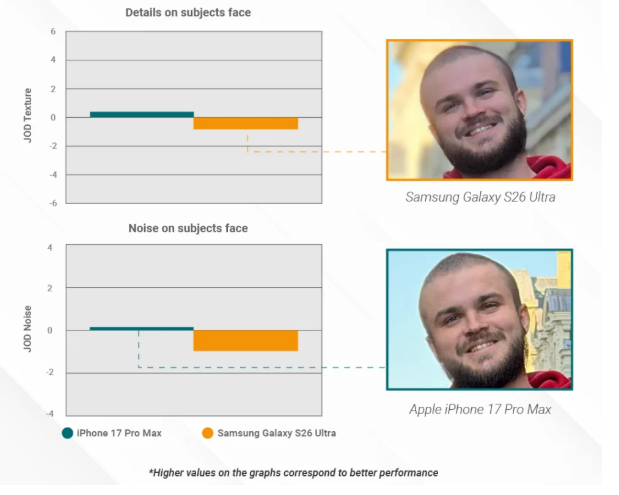
Another key advantage for the iPhone 17 Pro is its performance in difficult lighting conditions. The device continues to produce slightly cleaner photos in low light environments. It also handles portrait segmentation more effectively, resulting in more precise subject separation in complicated scenes.
Overall, Apple appears to maintain a small lead in camera consistency, particularly when shooting in demanding conditions.
(via)